> For the complete documentation index, see [llms.txt](https://documentation.soulver.app/llms.txt). Markdown versions of documentation pages are available by appending `.md` to page URLs; this page is available as [Markdown](https://documentation.soulver.app/documentation/variables.md).
# Variables
### Declaring variables
Declare a variable with the equals symbol '='.
```
discount = 10% | 10%
cost = $550 | $550
cost - discount | $495.00
```
A variable can be a single word, or an entire phrase.
### Global variables
Declare variables in the **definition sheet** to make them available across all your sheets and Soulver files. Use `=` just as you would for a regular variable.
On Mac, open **Settings > Variables** and click **Edit Definition Sheet…**.
Global variables in the definition sheet can also use calculations involving variables declared above them.
On Mac, you can also add global variables directly in **Settings > Variables** using the **+** button.
### Variable precedence
If the same variable name is defined in more than one place, Soulver uses this order:
1. **Local variables** declared above the current line in your sheet.
2. **Global variables in settings.**
3. **Variables in the definition sheet.**
For example, if the definition sheet sets `discount = 10%`, you can use `discount = 20%` in a particular sheet to override it for subsequent lines without changing the global value.
### Redefining variables
A variable can be redefined by giving it a new value.
The most recently defined value will be used on subsequent lines.
```
monthly rent = $1,900 // 2018 | $1,900
monthly rent = $2,150 // 2019 | $2,150
monthly rent / 4 people | $537.50
```
#### Variables can be added to and subtracted from
Use the `+=` and `-=` operators to modify the value of a variable

## Tips for working with variables
#### Peeking at a variable’s value
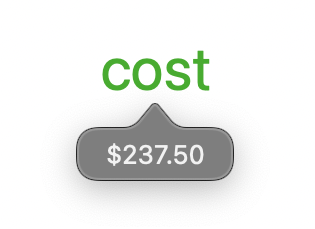
On Mac, peek at a variable’s value by holding down the shift key, and hovering over the variable.
Peeking at a variable value on Mac
On iPad & iPhone, select a variable to peek at its value.
Peeking at a variable value on iPad & iPhone
#### Auto-completing variable names
Instead of typing out a long variable name, you can press the **escape** key and then press **return** to quickly insert the entire variable name.

### Variable renaming
Soulver can automatically update any lines that reference a variable when you rename it.
On Mac, set **Update lines when a variable is renamed** in **Settings > Variables** to **Always**, **Ask**, or **Never**. On iPad and iPhone, choose the same options in **Settings > Editing > Variable renaming**. Rename the variable on its declaration line, then move the cursor to another line.
## Things to note about variable declarations
#### Variables must be declared before use
You can’t reference a variable *before* it has been declared.
This behaviour is consistent with how variables work in programming languages (but differs from Soulver 2).
#### Currency rounding does not apply to variable declaration lines
When you declare a variable in a currency, it will be displayed **without rounding** so it’s unambiguous what the actual value stored in the variable is.
When used on subsequent lines, currency rounding will apply like usual.
It’s clear what the actual value of "cost per day is"
#### Variable declarations can be excluded from the floating total
Use the View > Total options menu to configure whether the floating total should include or exclude variable declaration lines